
Wuerzburg: Baroque Franconia and Franconian Wine
A prince-bishops’ city on the Main with the largest ceiling fresco in the world at one end and a hill fortress at the other. Seventy minutes from Frankfurt, an hour from Rothenburg.
Why Wuerzburg
Four things clients do not expect
A ceiling that should have fallen
Tiepolo painted the largest ceiling fresco in the world on an unsupported vault. The palace roof burned in March 1945; the vault and the fresco survived.
Wine that pays for a hospital
The Juliusspital and the Buergerspital are among the largest estates in Germany and both are charitable foundations. The third, the Hofkeller, is in the cellars under the Residenz.
The glass on the bridge
From late morning the wine houses at either end of the Alte Mainbruecke sell a glass to take outside, and half the city stands on the bridge with it. No booking, no ceremony.
The Romantic Road starts here
An hour to Rothenburg, an hour to Nuremberg, seventy minutes to Frankfurt. Most itineraries pass within half an hour of the city and almost none of them stop.
Where it sits and what it is for
Wuerzburg is the northern gate of the Romantic Road and the capital of Franconian wine. It is seventy minutes from Frankfurt by car or fast train, an hour from Nuremberg, an hour from Rothenburg ob der Tauber and about three from Munich. That position is most of the argument for it: almost every itinerary moving between the Rhine and Bavaria passes within half an hour of the city, and almost none of them stops.
It is a prince-bishops’ city rather than a merchant one, and the shape follows from that. The Main runs through the middle, vineyards come down to the water on both banks, a palace closes one end of the old town and a hill fortress looks down on the other. The centre is walked end to end in twenty-five minutes, which makes Wuerzburg a strong half-day for parties on the move and a comfortable overnight for parties who came for the wine.
The Residenz, and the ceiling above the stairs
The Residenz is the reason to come and one of the great baroque interiors in Europe. Balthasar Neumann built it for the prince-bishops between 1720 and 1744, and it has been a UNESCO World Heritage site since 1981. Over the staircase, Giovanni Battista Tiepolo painted the largest ceiling fresco in the world, an allegory of the four continents spread across an unsupported vault that Neumann’s contemporaries fully expected to come down. It did not.
On 16 March 1945 an air raid burned out roughly nine tenths of Wuerzburg in about twenty minutes. The palace roof went; the vault and the fresco held, and an American art officer had a temporary roof put over them before the winter rain could finish what the fire had started. Clients who are told that before they walk up the stairs look at the ceiling rather differently.
Beyond the staircase there is the Kaisersaal with more Tiepolo, the stuccoed White Hall between the two, the Hofkirche, and the Hofgarten behind, which costs nothing and stays open late. The state rooms are not large and the middle of the day is when the groups arrive; an early slot with a licensed guide is a different building from a midday one.
The fortress, the old bridge, and the glass on it
Festung Marienberg stands above the vineyards on the left bank and was the seat of the prince-bishops for five centuries before they moved down the hill into the Residenz. The walk up through the vines takes about twenty-five minutes and pays for itself with the view back over the roofs and the river. Inside, the Museum fuer Franken holds the largest collection of Tilman Riemenschneider’s work anywhere — which matters to clients who have seen his Holy Blood Altar in Rothenburg and want the rest of him.
The Alte Mainbruecke below carries twelve baroque saints and no cars, and what happens on it is the detail guests repeat at home. From late morning the wine houses at either end sell a glass to take outside, and half the city stands on the bridge with it. The Brueckenschoppen has no ceremony, no reservation and no sense of itself as an attraction, which is why it works. Add the Dom St. Kilian and the Kaeppele on its hill, and the walking half of the day is full.
Silvaner, the Bocksbeutel and who owns the vineyards
Franconia pours dry and pours Silvaner, which is nothing like the Riesling clients expect after the Rhine: drier, earthier, tasting of the shell limestone it grows on. The bottle makes its own case — the Bocksbeutel is flat and round, holds the same 750 millilitres as everyone else and will not fit a normal wine rack.
The unusual part is the ownership. Two of the largest estates in the country sit inside this city and both are charities: the Juliusspital and the Buergerspital are hospital foundations, and the wine still pays for the care of the elderly. The third, the Staatlicher Hofkeller, lies in the cellars under the Residenz, which turns a tasting into an architectural visit as well. All three receive small private parties when asked in advance, and a car with a driver means nobody has to choose between the tasting and the road back.
The Romantic Road and where the day goes next
The Romantic Road starts here and runs some 350 kilometres south to Fuessen. Rothenburg ob der Tauber is the first stop on it and an hour away, which makes the classic two-centre Franconian day, and Neuschwanstein sits at the far end of the same road. Northbound, Frankfurt is seventy minutes and the Rheingau an easy addition for clients comparing Silvaner with Riesling in one week. Eastbound, Nuremberg is an hour.
Season and timing
May to October is the season and September is the best of it: the harvest is on the slopes, the light is long and the terraces are still open. The Mozartfest fills the Residenz and its garden in early summer and is worth planning around rather than into, because rooms tighten for it. The wine festivals through summer and autumn are cheerful rather than refined, and we say which ones suit which clients. Winter is quiet and the Residenz at its emptiest, which some clients count as a recommendation.
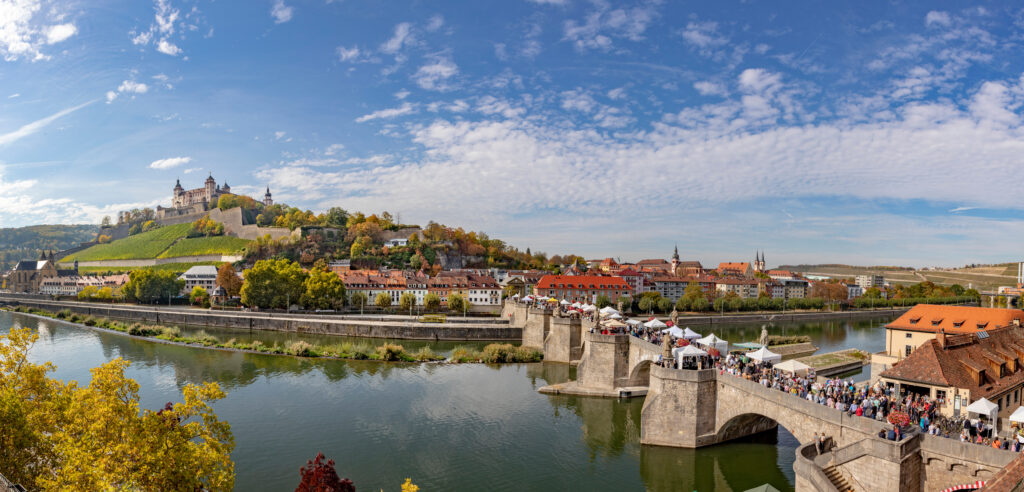
The fortress, the vines and the walk between them
Festung Marienberg was the seat of the prince-bishops for five centuries before they moved down into the Residenz. The climb through the vineyard takes about twenty-five minutes and the view back over the river is the one clients photograph.
Inside, the Museum fuer Franken holds the largest collection of Tilman Riemenschneider’s carving anywhere — the reason clients who liked the Holy Blood Altar in Rothenburg should be sent up the hill.
Practical
How long, when, and how it connects
How much time does Wuerzburg need?
A half-day covers the Residenz and the old town if the party keeps moving. A full day adds the fortress and a wine estate. An overnight is what we suggest when the wine is the point, because the tastings sit in the late afternoon and nobody should be driving on after them.
Does the Residenz need to be booked ahead?
The state rooms are seen with a guide and the middle of the day is when the groups arrive. We hold an early slot and put a licensed guide with the party, which is a different visit from walking up at noon in August.
Can clients taste at the wine estates?
Yes, and properly. The Juliusspital, the Buergerspital and the Staatlicher Hofkeller under the Residenz all receive small private parties when they are asked in advance. It is a booking, not a drop-in, and it wants about a fortnight.
How does Wuerzburg fit into a longer itinerary?
It is the northern end of the Romantic Road. The usual routing is Frankfurt or the Rhine, then Wuerzburg, then Rothenburg an hour south, then Munich or Nuremberg. Going the other way it is the last Franconian stop before the Rheingau.
Put Wuerzburg in the routing
Send the date, the party and where they are coming from. We come back with a Residenz slot, a guide, the estates that will receive them and net rates.
Request net rates