
Frankfurt
Legends of the Rhine 5 days/ 4 nights
Legends of the Rhine – Five-Day Private Tour of the Romantic Rhine Valley Between Bingen and Koblenz the Rhine cuts…
View tourWhere most clients enter Germany and few of them stay. A half-day city done well, an hour from the Rhine gorge, and an airport that decides how the trip starts.
Why Frankfurt
Two railway stations at the airport
Terminal 1 has a long-distance station for ICE services and a separate regional station for the S-Bahn into the city. They are not the same place, and clients routinely go to the wrong one.
The old town is a reconstruction
The centre burned in March 1944. The quarter between the Roemer and the cathedral reopened in 2018. Say so — the argument about rebuilding it is more interesting than a surviving old town.
Fair weeks break the budget
During the large fairs, hotel rates multiply and availability goes months ahead. We check the calendar before confirming a night, and base clients in Wiesbaden or the Rheingau when the dates are impossible.
The Rhine gorge is an hour west
Ruedesheim to St. Goar by boat, the Marksburg above it — the only hill castle on the Middle Rhine never destroyed — and back in time for dinner in the city.
More international clients enter Germany at Frankfurt than anywhere else, and most leave again within two hours of landing. That is often the right call and it is also a missed evening. Frankfurt is a half-day city done well, and the half-day is better than its reputation: a rebuilt old town, a first-rate picture gallery, the only real high-rise skyline in the country, and apple wine taverns across the river that have not changed in fifty years.
What Frankfurt is not is a place to give three nights on a first Germany trip, and we say so before it is quoted. Its value is as a first night, a last night, or a base for the Rhine and Heidelberg — and as the place where an arrival either goes smoothly or sets the tone for everything after it.
Frankfurt is the largest airport in Germany and a building clients get lost in. Two terminals are in use and a third is under construction. Terminal 1 has its own long-distance station with through ICE services and a separate regional station for the S-Bahn, which reaches the city’s main station in about fifteen minutes. The two are not the same place and clients routinely go to the wrong one.
Meet and greet here is not a courtesy. It is the difference between a tight connection working and not working. Our agent meets the party in the arrivals hall, or at the aircraft door where that has been booked separately, handles the baggage and walks them to the car or the onward gate. What we need is the flight number, the terminal, the party size and a mobile that will be on when the wheels touch.
The medieval centre burned in the air raids of March 1944. The Roemerberg, with the stepped gables of the Roemer town hall, went back up in the decades after the war; the quarter between it and the cathedral was rebuilt only recently and opened in 2018, part faithful reconstruction and part new building on the medieval street plan. Clients should be told it is a reconstruction. Told honestly it beats a surviving old town, because the argument over whether to build it ran for thirty years.
Around it: the cathedral where the Holy Roman Emperors were crowned, the Paulskirche where the first freely elected German parliament sat in 1848, and Goethe’s birthplace, also rebuilt, a few streets west.
The south bank carries a row of museums within a twenty-minute walk of one another. The Staedel is the serious one, with holdings running from the fourteenth century to the present; beside it are the Liebieghaus for sculpture, the German Architecture Museum, the film museum and the museum of applied art. For a client with one free afternoon and rain outside, this is the answer.
For the skyline, the Main Tower has a public platform around 200 metres up, the only one in the city open to everybody. On a clear evening it shows the Taunus to the north and the Rhine plain to the west, which explains the region faster than a map.
Across the river in Sachsenhausen the taverns serve Apfelwein poured from a grey-and-blue stoneware jug into a ribbed glass, with hand cheese and green sauce alongside. It is sour, it is local, and roughly half of guests like it. We take clients anyway, because it is the one thing in Frankfurt not trying to be anywhere else.
The trade fairs are the practical constraint on everything. Frankfurt hosts some of the largest fairs in the world, and during them hotel rates multiply and availability disappears months ahead. The Book Fair in October is the best known and not the most disruptive. We check the calendar before confirming any Frankfurt night; when the dates are impossible we base the client in Wiesbaden or the Rheingau and drive in.
This is where a second night earns itself. Ruedesheim and the Upper Middle Rhine Valley, World Heritage from Bingen down to Koblenz, are an hour west; the classic day puts the party on a boat between Ruedesheim and St. Goar and visits the Marksburg, the only hill castle on the Middle Rhine never destroyed. Heidelberg is an hour south, Wiesbaden and Mainz forty minutes, and the Rheingau growers are close enough that a proper tasting still gets everyone back for dinner. Rothenburg is two and a half hours and belongs on a routing rather than in a day trip.
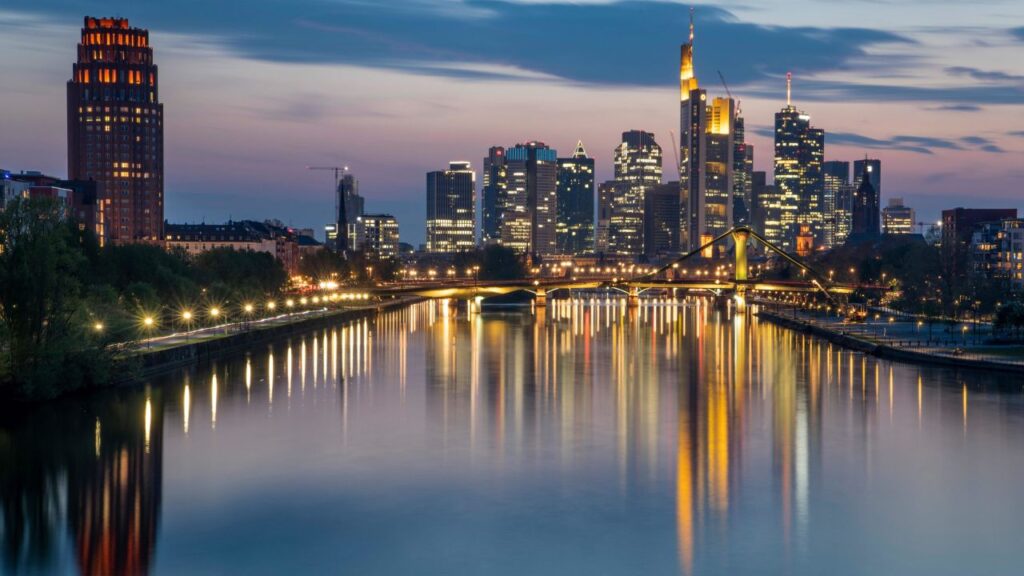
Frankfurt is the one German city with a genuine high-rise skyline, and it stands a few hundred metres from a square of rebuilt half-timbering. Clients photograph the contrast more than either half on its own.
The Main Tower platform at around 200 metres is the only one open to everybody, and on a clear evening it shows the Taunus to the north and the Rhine plain to the west — which is the fastest way to explain where the next three days are going.
From the programme
Frankfurt
Legends of the Rhine – Five-Day Private Tour of the Romantic Rhine Valley Between Bingen and Koblenz the Rhine cuts…
View tour
Frankfurt
Best German Winegrowing Estates around Frankfurt – A Private Rheingau Day Tour Forty minutes west of Frankfurt the Rhine turns…
View tourQuestions advisors ask
A named agent meets your client with a board in the arrivals hall, or at the aircraft door where the airport’s own service has been booked, takes the baggage in hand and walks the party to the car or the onward gate. You get the agent’s name, the meeting point and a mobile number before your client boards. We track the flight rather than the schedule, so a diversion or a gate change moves the meeting point with it.
Yes, and Frankfurt is one of the airports where it reliably exists. That is worth stating plainly because it is not true everywhere in Germany: it is limited at some airports and absent at several regional ones. Fast-track is an airport product, not something an agency can conjure where the airport does not offer it.
More than the ticket suggests once a terminal change, passport control and a baggage re-check are involved. This is the strongest case for assistance: an agent who meets the inbound and walks the party to the onward gate turns an anxious hour into a non-event. Send us the two flight numbers and we will tell you honestly whether the connection is realistic.
One night, yes, and it is usually the arrival or departure night rather than a stay in its own right. The half-day covers the Roemerberg, the cathedral and either the Staedel or the Main Tower, with apple wine in Sachsenhausen in the evening. A second night is only worth selling if the Rhine gorge or Heidelberg is going into the programme.
Send the flight number and the terminal for the arrival, and the dates for anything after it. You get a named agent and a meeting point back before your client boards.
Request net ratesAdvisor enquiries only · Virtuoso Preferred Supplier since 2013